
Global COPD Scenario Analysis
Global trial planning under realistic constraints
This illustrative COVARIS case examined whether a five-country COPD trial footprint contained meaningful differences in weather and temperature-related environmental context.
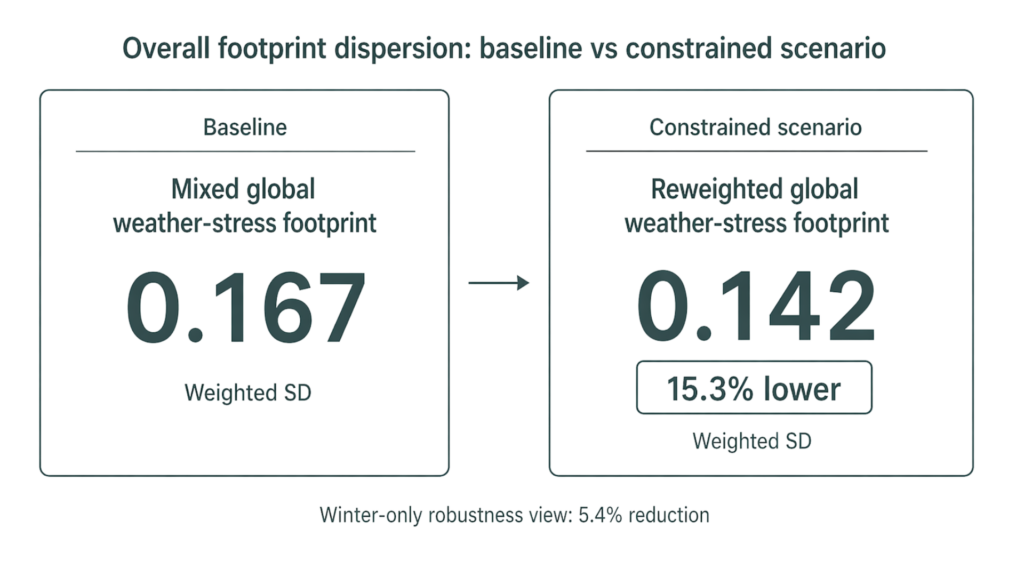
Using a combined temperature and humidity stress measure, the analysis showed that constrained adjustments to regional enrollment allocation could reduce calculated environmental dispersion by 15.3% while retaining all countries and regions.
A winter-only robustness analysis showed a smaller but still positive reduction of 5.4%.
Why this case was built
Early COVARIS work showed that environmental differences can be identified within countries and across multinational trial footprints.
The next question was more practical: could a realistic global COPD trial setup be improved through moderate changes in regional enrollment allocation, while keeping all countries and regions in scope?
This case was designed to test that question under explicit operational constraints.
Clinical trial setup
The case used a realistic global phase 3-style COPD trial footprint covering the United States, Germany, Spain, Brazil and South Korea.
The footprint was analysed as one integrated global setup. All countries and internal regions remained in scope in both the baseline and constrained scenarios.
The case therefore tested whether moderate changes in planned enrollment allocation could improve overall environmental dispersion without changing the country list or broader study structure.
Disease area: COPD
Countries: USA, Germany, Spain, Brazil, South Korea
Geography structure: Global multi-country phase 3-style setup
Scenario logic: All countries retained, all regions retained, moderate enrollment reweighting only
Disease-relevant environmental variable
The case used a combined Respiratory Weather Stress Index based on temperature and humidity.
The rationale was that respiratory weather stress is shaped by both variables. Humidity affects how temperature-related conditions are experienced and was therefore included in the same analytical framework.
Overall dispersion across the trial footprint was calculated as the weighted standard deviation of this combined index. On this page, the result is described more simply as environmental dispersion across the planned trial footprint.
Main result
Under the constrained scenario, calculated environmental dispersion across the global COPD trial footprint was reduced by 15.3% compared with baseline.
All countries and internal regions remained in scope. The improvement came from moderate changes in planned enrollment allocation rather than from country removal or unrestricted redesign.
A winter-only robustness analysis showed a smaller but still positive reduction of 5.4%.
Country-level shifts
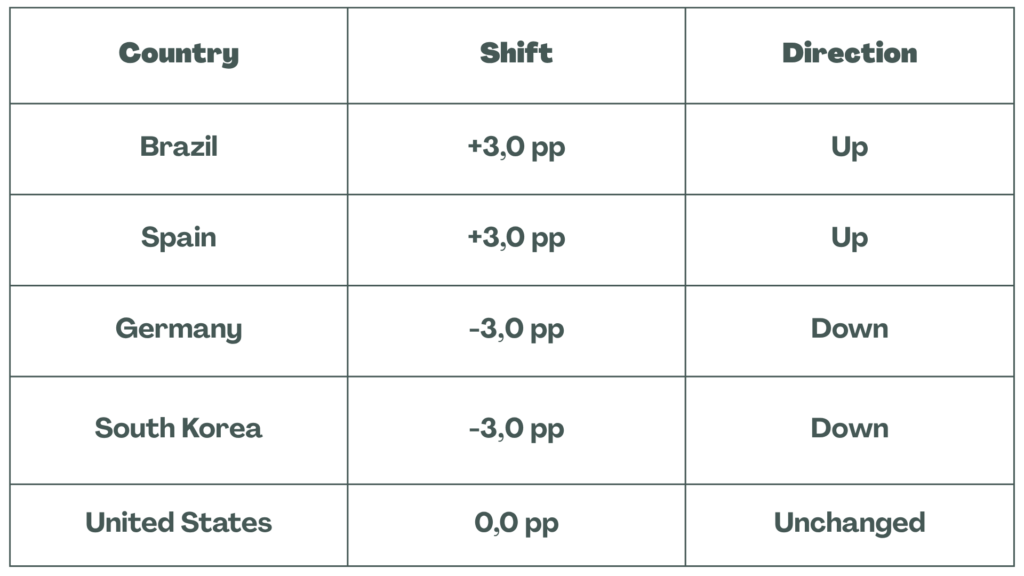
The overall reduction did not depend on removing a country or making one dominant change.
Instead, it resulted from several moderate shifts in planned enrollment allocation across countries and internal regions.
At country level, Brazil and Spain were moderately upweighted, Germany and South Korea were moderately downweighted, and the United States remained unchanged.
Download the full case report to see the exact country-level and subnational enrollment shifts.
This makes the case relevant to realistic global trial planning, where improvements often come from cumulative adjustments rather than wholesale redesign.
Why it matters
Global trial planning rarely takes place in a fully flexible design space. Countries, regions, recruitment realities, timelines and commercial priorities all shape what can realistically be changed.
This case shows that meaningful improvements may still be possible within those constraints. The value may lie not in removing countries or redesigning the study, but in making several plausible enrollment shifts across countries and regions before protocol assumptions are locked.
What this case shows
This case demonstrates that a realistic global COPD trial footprint can contain meaningful cumulative differences in environmental context before protocol lock.
It also shows that moderate enrollment adjustments across countries and regions can reduce calculated environmental dispersion without removing countries or changing the broader study structure.
The practical value lies in making those differences visible early enough to support more disciplined planning discussions.
Download sample report
See the structure, analytical logic and level of detail of an illustrative COVARIS sponsor-facing report based on this case.
The report includes the baseline footprint, constrained scenario, country-level and subnational enrollment shifts, robustness analysis and interpretation.

COVARIS helps sponsors and CROs make relevant external context visible across trial countries, regions, study windows and selected assessment settings.
COVARIS does not predict outcomes or prove causal effects. It provides external context intelligence for sponsor-led planning, evidence generation and interpretation.
COVARIS ApS
2100 Copenhagen
Denmark
+45 25 30 30 28
CVR-no.: 46484673